
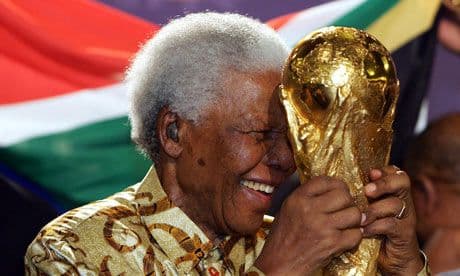
Former South Africa president Nelson Mandela holds the world cup trophy ahead of the tournament that was held in south Africa on 2010.
Africa's journey at the FIFA World Cup
Africa's relationship with the FIFA World Cup is a story almost a century in the making. What started with one pioneering nation in 1934 has evolved into a remarkable journey marked by resistance, resilience, historic achievements, and a determination that the global football community often failed to fully appreciate.
The story began in 1934 when Egypt became the first African country to participate in a FIFA World Cup. Taking part in the tournament's second edition in Italy, Egypt earned qualification by defeating Palestine in a playoff before facing Hungary in the opening round. Although they were defeated 4-2, their appearance represented far more than the result. It was a historic breakthrough that placed Africa on football's biggest stage. Yet after Egypt's landmark participation, the continent would wait another 36 years before seeing another representative at the World Cup.
In the decades that followed, African nations repeatedly attempted to qualify, only to encounter a system heavily stacked against them. FIFA's qualification structure grouped Africa with Asia and, at times, Oceania, forcing multiple continents to compete for a single place—or occasionally no place at all. Some nations withdrew in protest, while others were eliminated through a framework that severely restricted African participation. For more than thirty years, Africa fought for recognition and opportunity. The boycott of 1966 was the culmination of years of frustration.
When the World Cup arrived in England in 1966, no African nation took part. This was not due to a lack of quality or failure on the pitch. Instead, African countries collectively refused to participate after FIFA insisted that Africa, Asia, and Oceania share a single qualification berth. Ghana, under the leadership of Kwame Nkrumah and football administrator Ohene Djan, played a central role in mobilizing opposition through the Confederation of African Football alongside other African nations. The pressure worked. FIFA was compelled to act, and by the 1970 World Cup, Africa had secured its own guaranteed qualification spot. It was a landmark victory for the continent and proof that collective action could bring change.
From Egypt's solitary appearance to Morocco's historic semifinal breakthrough, Africa has consistently exceeded expectations and challenged assumptions about its place in world football.
A major milestone arrived in 1978 when Tunisia defeated Mexico 3-1, becoming the first African nation to win a World Cup match. Four years later, Algeria stunned the football world by defeating West Germany 2-1 at the World Cup in Spain. Despite earning one of the tournament's most famous victories, Algeria failed to progress after the controversial match between West Germany and Austria that became known as the "Disgrace of Gijón." Africa had proven its quality on the pitch, only to be undermined by circumstances beyond its control.
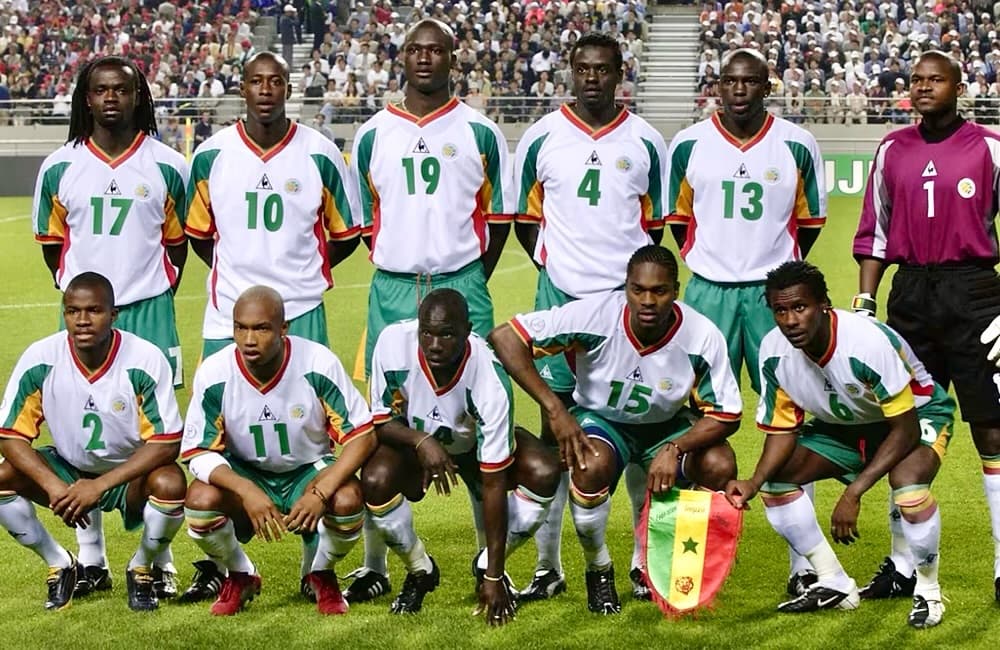
The 2002 World Cup delivered another unforgettable chapter. Senegal announced themselves in spectacular fashion by defeating defending champions France in their opening match. They continued their impressive run all the way to the quarterfinals, becoming only the second African nation to reach that stage. Papa Bouba Diop's winning goal remains one of the most iconic moments in World Cup history.
In 2010, Africa welcomed the world by hosting the FIFA World Cup for the first time. South Africa provided the stage, while Ghana carried the continent's hopes on the pitch. The Black Stars reached the quarterfinals before suffering a heartbreaking penalty shootout defeat to Uruguay in a match forever associated with Luis Suárez's deliberate handball.
Twelve years later, Morocco achieved what no African nation had managed before. At the 2022 FIFA World Cup, the Atlas Lions defeated both Spain and Portugal on their way to becoming the first African team to reach a World Cup semifinal. Although their run ended against France, Morocco had broken another barrier. Nearly nine decades after Egypt's first appearance, Africa had finally reached the last four.
Now, in 2026, another historic chapter awaits. For the first time ever, ten African nations will compete at the FIFA World Cup—the continent's largest representation in tournament history. From a lone pioneer in 1934 to ten nations on football's grandest stage, Africa's World Cup journey continues to grow, inspire, and redefine what is possible.